
Choosing the Right Electric Motor for Agricultural Ventilation
Understanding PSC and ECM Motors in Livestock Facilities
Proper ventilation is one of the most critical systems in modern livestock production. Whether in swine, poultry, or dairy facilities, ventilation controls temperature, humidity, gas concentrations, and overall air quality. Reliable fans and the motors that power them play a direct role in animal health, feed efficiency, and operational performance.
For producers and maintenance technicians, selecting the right electric motor is about more than horsepower or price. Motor quality, efficiency, and application suitability can significantly impact reliability, operating costs, and maintenance requirements.
This article explains how electric motors work in agricultural ventilation systems, the importance of motor quality, and the differences between two common motor technologies used in barn fans: PSC motors and ECM motors.
Why Electric Motor Quality Matters in Livestock Facilities
Electric motors are the workhorses behind ventilation systems, feed systems, pumps, and conveyors. In ventilation applications specifically, they often operate continuously in harsh environments such as:
• Dust
• High humidity
• Ammonia exposure
• Temperature swings
• Continuous operation during peak seasons
Because of these conditions, motor quality directly affects farm productivity.
A well-built motor should provide:
• Consistent airflow performance
• Low failure rates
• Thermal protection
• Proper sealing and enclosure
• Long insulation life
Inside every electric motor are key components such as the stator windings, rotor, bearings, and cooling systems that convert electrical energy into mechanical rotation. The stator produces a rotating magnetic field which induces current in the rotor, causing it to spin and drive connected equipment.
This electromagnetic principle has powered agricultural equipment for decades, but the quality of materials and engineering used in the motor determines how well it performs under real-world farm conditions.
For ventilation fans especially, reliability is essential. A failed fan motor during hot weather can quickly create dangerous conditions for livestock.
Electric Motors in Agricultural Ventilation
Most agricultural ventilation systems use axial fans, which move air parallel to the fan shaft and are commonly installed in barn walls or ceilings.
These fans may be:
• Direct drive – fan blades mounted directly on the motor shaft
• Belt drive – motor drives the fan using pulleys and belts
Many barn fans use TEAO (Totally Enclosed Air Over) motors. This means the motor relies on airflow from the fan itself for cooling.
Because of this design, motor performance and airflow are closely linked. Running the motor too slowly or under improper conditions can lead to overheating or reduced lifespan.
Since ventilation needs change throughout the day and seasons, the ability to control fan speed is an important consideration when selecting motor technology.
Two common motor types used in agricultural ventilation systems are:
• PSC (Permanent Split Capacitor) motors
• ECM (Electronically Commutated Motors)
Each has advantages and limitations.
PSC Motors: Proven and Reliable
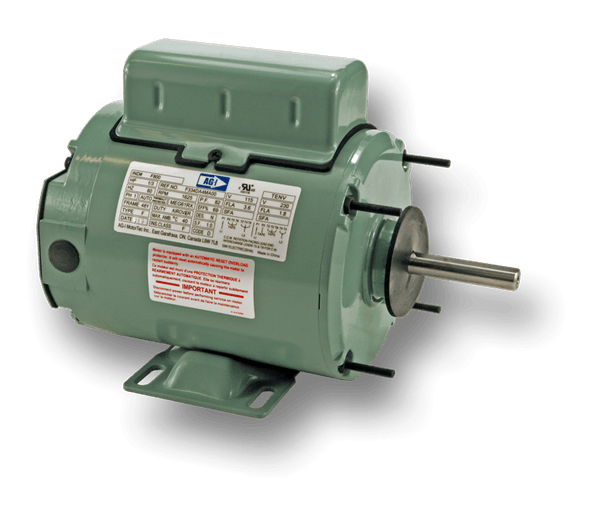
PSC motors have been used in agriculture for decades and remain one of the most common motor types in ventilation systems.
These motors use a capacitor to create a rotating magnetic field that drives the rotor. Their design is simple, reliable, and relatively inexpensive.
PSC motors are commonly used in:
• Direct-drive agricultural fans
• Small ventilation systems
• Gate motors and door systems
• Appliances and HVAC equipment
One advantage of PSC motors is their ability to operate with standard fan speed controllers.
Typical PSC fan motors used in agricultural ventilation run around 1625 RPM or 1060 RPM and can operate over a variable speed range using common fan controls. This makes PSC motors well suited for staged ventilation systems where fans gradually increase speed as barn temperatures rise.
Advantages of PSC Motors
PSC motors remain popular in agricultural ventilation because they offer:
• Proven technology with long field history
• Lower purchase cost
• Simple electrical design
• Easy replacement and servicing
• Compatibility with common fan speed controls
For many livestock barns, PSC motors provide a cost-effective and dependable solution.
Limitations of PSC Motors
However, PSC motors do have some limitations.
Because they are induction motors, their efficiency drops significantly at lower speeds. Running them slowly for extended periods can also reduce cooling airflow and cause thermal protection to trip.
For example, TEAO fan motors rely on airflow from the fan itself for cooling. If the fan speed is reduced too much, the motor may overheat and shut down.
Additionally, PSC motors cannot automatically compensate for system changes such as increased static pressure from dirty filters or airflow restrictions.
These limitations have led to growing interest in newer motor technologies.
ECM Motors: The Next Generation of Fan Motors
Electronically Commutated Motors (ECM) represent a major advancement in electric motor technology.
Unlike PSC motors, ECM motors use permanent magnets and integrated electronic controls to manage motor operation. These motors include an internal microprocessor that regulates speed, torque, and airflow.
This design provides several advantages in ventilation applications.
Higher Energy Efficiency
One of the biggest benefits of ECM motors is efficiency.
ECM motors are typically more efficient at full speed than conventional induction motors. At lower speeds, the efficiency advantage can increase to around 30 percent, which is where the biggest ROI on energy savings is generated.
For livestock facilities running dozens or even hundreds of ventilation fans, this energy savings can significantly reduce operating costs.
Precise Airflow Control
ECM motors can maintain constant airflow even as system conditions change.
If static pressure increases due to higher temperatures or airflow restrictions, the motor automatically increases speed to maintain airflow. This helps maintain consistent barn conditions for livestock.
Wide Speed Range
ECM motors can operate across a very wide speed range, typically from 5 to 100 percent output, generally programmed to start around 200 RPM, though they can be run lower in the right setup.
This allows ventilation systems to precisely match airflow with animal requirements. In some cases, a single ECM fan can replace multiple staged fans used in traditional ventilation systems.
Lower Maintenance
Because ECM motors operate efficiently and with optimized control, they often run cooler and require less maintenance compared to conventional motors.
Limitations of ECM Motors
While ECM motors offer impressive advantages, they are not always the right solution for every application.
Higher Initial Cost
ECM motors typically cost more upfront than PSC motors due to their integrated electronics and control systems.
For facilities with many fans, the initial investment can be significant.
Electronics Sensitivity
Because ECM motors contain electronic components and microprocessors, they can be more sensitive to:
• Power quality issues
• Voltage spikes
• Harsh electrical environments
In dusty agricultural environments, proper protection of the electronics becomes important.
Programming and Compatibility
Unlike PSC motors, ECM motors usually require factory programming tailored to specific applications and cannot easily be programmed in the field.
They also require compatible controllers, often using 0 to 10 VDC control signals for speed regulation. This means ventilation system integration must be planned carefully.
Choosing the Right Motor for Your Application
When selecting motors for agricultural ventilation systems, there is no single solution that fits every operation.
PSC motors remain an excellent option for:
• Standard barn ventilation fans
• Simple staged ventilation systems
• Cost-sensitive installations
• Easy field replacement
ECM motors are ideal when operations require:
• Maximum energy efficiency
• Precise airflow control
• Advanced ventilation management systems
• Reduced long-term operating costs
For many livestock operations, the best solution may involve a combination of technologies depending on barn design, control systems, and operational goals.
Final Thoughts
Ventilation is one of the most important systems in livestock production, and the electric motors behind those fans play a critical role in maintaining animal health and facility performance.
Understanding the strengths and limitations of different motor technologies helps producers, equipment buyers, and maintenance technicians make informed decisions.
PSC motors provide proven reliability and affordability, while ECM motors offer advanced efficiency and airflow control.
Selecting the right motor ultimately comes down to balancing performance, cost, reliability, and system design. As ventilation systems continue to evolve, both technologies will continue to play important roles in modern agricultural facilities.